Two Years at Wollo University: Scaling 12 Years of Mathematical Excellence Across Ethiopia
Math camps did not begin at Wollo University by accident. They are part of a longer national story that stretches back more than a decade, when Bahir Dar University began running mathematics camps with support from SAMI. The original idea was simple but powerful: give students space to think, remove exam pressure, and allow mathematics to breathe. Over time, that culture grew steadily and began to spread to other institutions that recognised the value of learning environments built around curiosity rather than memorisation.
In 2024, Wollo University decided to join this growing movement. What followed marked the beginning of a new chapter for mathematics enrichment in South Wollo. This blog documents what happened during the first two years of implementation, and explains why the third year will be critical in strengthening the model.
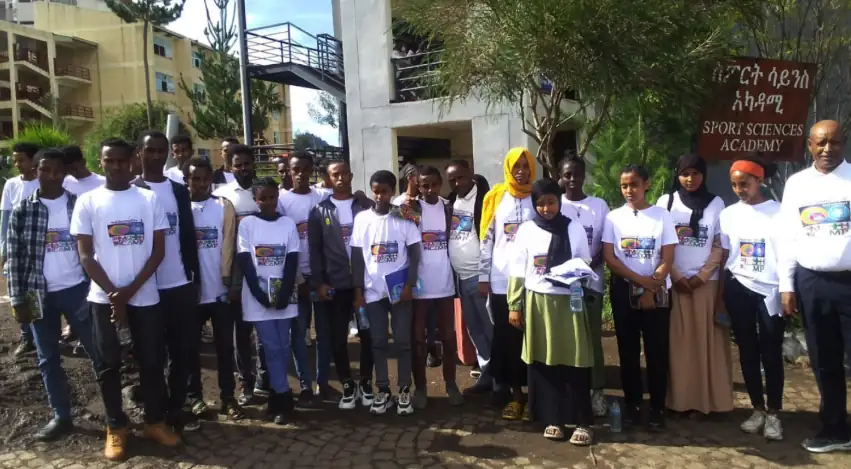
The first Wollo University Maths Camp took place from August 26 to 30, 2024, in Dessie. This first year was designed as a proof of concept—a way to test whether the model that had worked elsewhere could be successfully adapted to the local context.
The camp hosted 30 students drawn from more than 20 secondary schools across South Wollo. Interest was strong from the beginning, with more than 50 students applying for the limited spaces available. Budget constraints meant that careful selection was necessary, and students were chosen using a structured system that assigned 65% weight to overall school performance, 30% weight to mathematics achievement, and a 5% boost for female applicants to encourage gender balance. In the end, 14 girls and 16 boys were selected to participate.
The teaching team for this first year was intentionally modest. There were no in-person international volunteers, and only one virtual presenter joined remotely from the United States. The rest of the facilitators were local academics, primarily from Wollo University, with one important contributor from Bahir Dar University, Dr. Abdu Mohammed. This structure proved significant, as it established from the beginning that the camp would rely primarily on local expertise rather than external support.
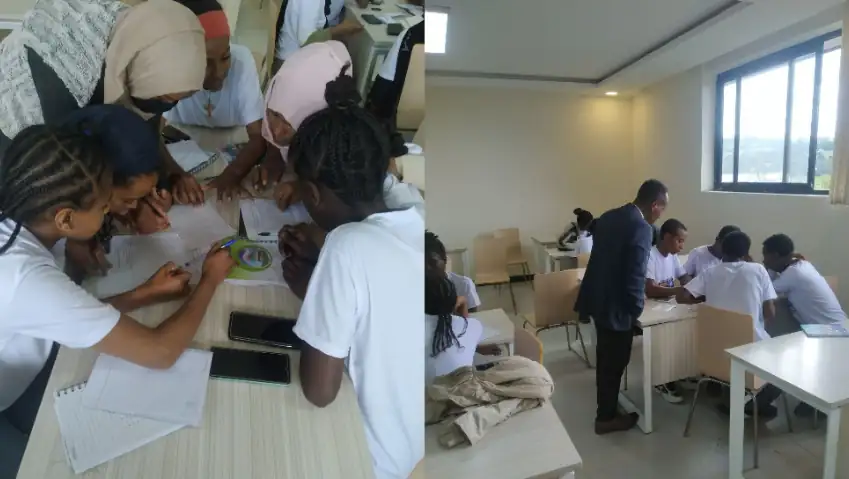
From the start, the programme avoided the familiar structure of school-based teaching. Instead of lectures tied to examination content or pressure to cover large volumes of material, students were encouraged to begin with exploration and experimentation.
One of the first activities involved speed mathematics exercises conducted in small groups, where students observed how thinking changes under time pressure. During one session, most teams achieved nearly identical results, leading facilitators to declare multiple winners. This decision was intentional, demonstrating that improvement in speed comes from consistent practice rather than fear of failure.
Students were also introduced to mathematical modelling through a simulation of disease spread. Rather than beginning with formulas, the activity started with movement and observation. Students tracked their own interactions and used these patterns as data, gradually moving from simple reasoning to graphs and structured questions. Later discussions extended the same model to rumours, computer viruses, and social networks, helping students understand how mathematical models are built step by step rather than presented as finished solutions.
Technology-based sessions introduced tools that were new to many participants. Using GeoGebra, students constructed geometric shapes, measured angles, and animated objects, turning abstract diagrams into interactive structures. They also explored introductory concepts in Python programming and basic cryptography, learning how mathematics connects to fields such as artificial intelligence and cybersecurity. These sessions were not designed as full programming courses, but as entry points that revealed the practical relevance of mathematics in modern technologies.
Alongside these structured activities, lighter sessions added an element of play to the learning process. Students solved puzzles, explored number tricks, completed magic squares, and played games involving prime numbers. At the end of the week, participants recorded their experiences in anonymous journals, writing honest reflections about what they had learned. Many described the same realisation in different words: mathematics felt different in this environment—more engaging, more understandable, and less intimidating.
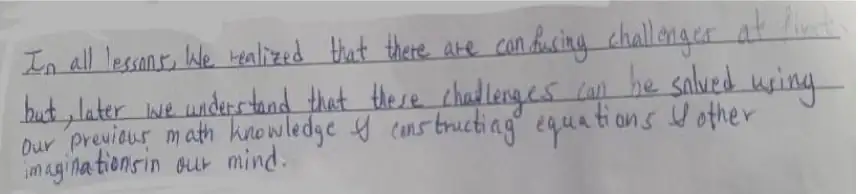
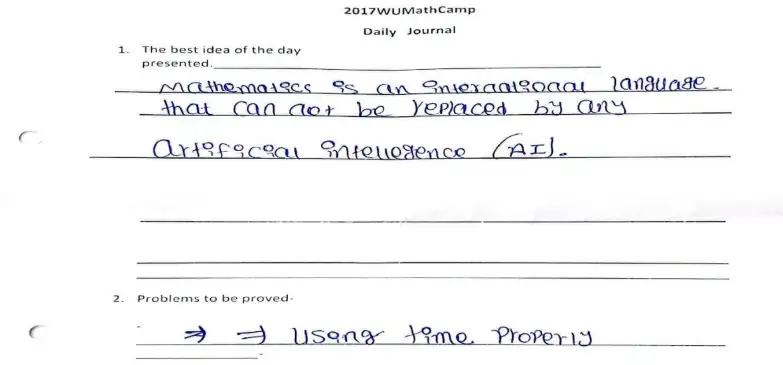
One journal note stood out:
Building Up: 2025 (Ethiopia:2017) Raised the Bar
The second camp, held in August 2025, built directly on the lessons learned from the first year. Once again, 30 students were selected, but this time five participants returned from the 2024 camp, creating an important shift in how the programme functioned.
These returning students did not simply repeat the experience. Instead, they took on informal leadership roles, helping new participants understand the rules, guiding group discussions, and supporting collaborative tasks. In this way, learners became carriers of the camp culture, reinforcing shared values and expectations while helping maintain continuity between cohorts.
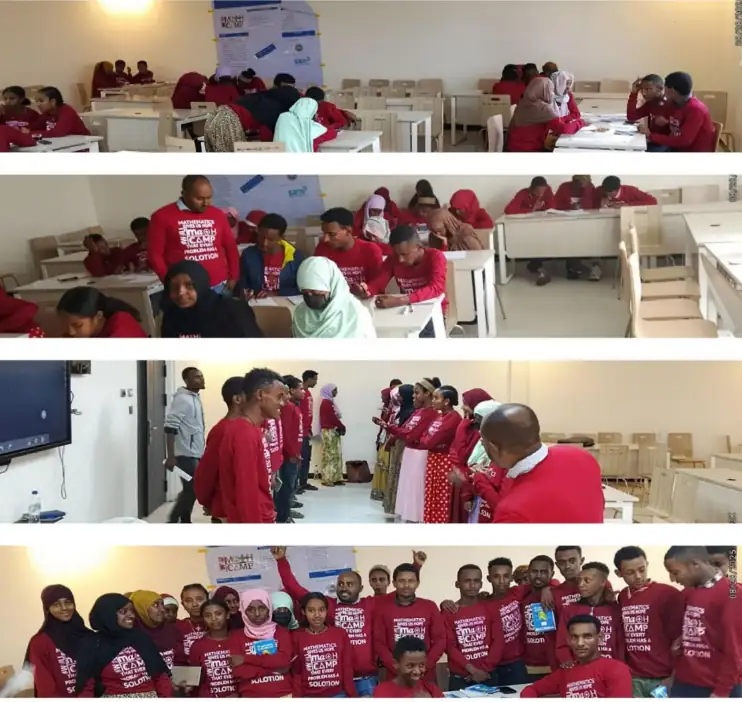
The academic content also became more structured. Speed mathematics returned as a central activity, but this time students explored deeper strategies such as decomposition, pattern recognition, and selected Vedic techniques. They applied these methods to practical situations such as budgeting and estimation, showing how mental mathematics supports everyday decision-making.
Mathematical modelling sessions were expanded as well. The disease-spread simulation used in the previous year was revisited, but discussions were extended to include graph interpretation, questioning assumptions, and proposing possible interventions. These conversations introduced elements of research thinking, encouraging students to analyse results critically rather than accepting them at face value.
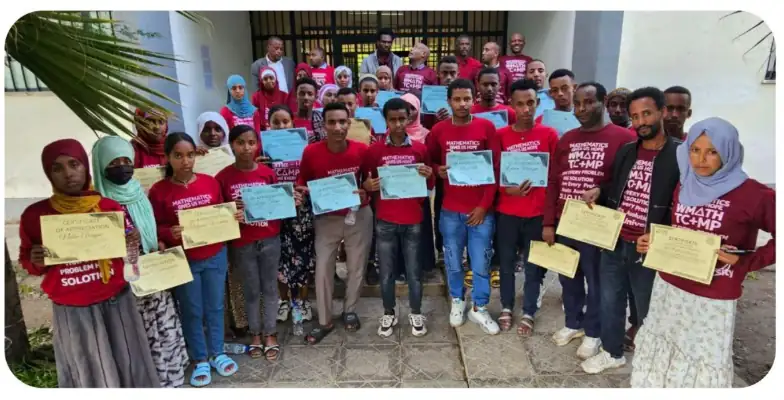
Technology sessions continued to grow in importance. Python programming returned alongside cryptography activities, with additional emphasis placed on understanding how number theory supports secure communication. By revisiting familiar tools while increasing the level of complexity, facilitators were able to deepen understanding without overwhelming participants.
At the conclusion of the 2025 camp, journalists were invited to observe and document the experience. Students themselves contributed to recording the activities, and a short documentary was produced and shared with participants. This marked an important transition, as what began as an internal experiment became visible to a wider audience.
What the Journals Reveal
The student journals collected at the end of the second year revealed noticeable growth in confidence compared to the reflections written in 2024. Many students described feeling more comfortable speaking in front of groups, collaborating with peers, and working through unfamiliar problems without relying on memorised formulas.
Several reflections focused on teamwork and communication, noting how group activities encouraged participation and shared responsibility. One particularly memorable comment captured the depth of their engagement:
“Mathematics is an international language that cannot be replaced by any artificial intelligence (AI).”
Statements like this highlight the broader purpose of the camps. Rather than focusing solely on advanced content, the programme works to reduce the research gap by changing how students think about mathematics itself. Participants learn how ideas are formed, tested, and refined through experimentation and discussion.
Learning extended beyond the student participants. Local volunteers refined their facilitation techniques, while university staff tested new teaching materials and adapted them to the Ethiopian context during preparation periods. This continuous improvement strengthened the sustainability of the programme and built local capacity for future expansion.
Looking back across both years, one consistent feature has been the emphasis on sustainability. Wollo University provided essential logistical support, including classrooms and accommodation, while SAMI contributed some essential funding. This partnership allowed the programme to function effectively without relying on expensive infrastructure.
Technology played an important supporting role throughout the camps. Students engaged with tools such as Python, GeoGebra, and cryptographic simulations, gaining exposure to modern applications of mathematics. Daily schedules combined structured lessons with puzzles, physical activities, and informal games that continued after dinner. Students shared meals, worked in teams, and participated in house-based systems that encouraged responsibility and cooperation.
These shared experiences created a strong sense of community, reinforcing the idea that learning mathematics can be both collaborative and enjoyable.
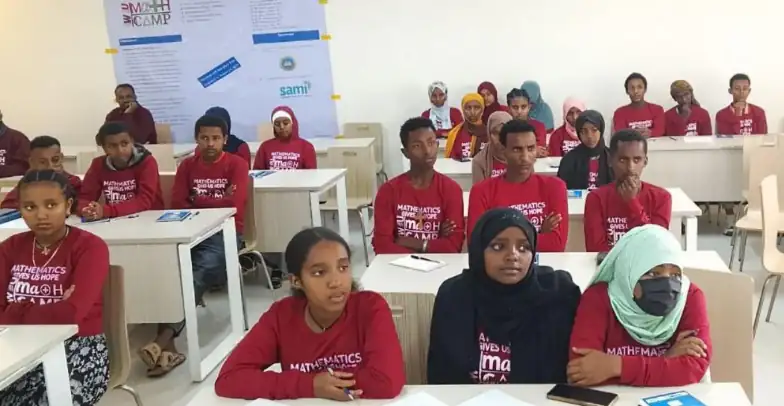
Today, Wollo University stands as part of a wider educational culture that began at Bahir Dar University more than twelve years ago. The challenge now is not simply to continue running camps, but to deepen local ownership and strengthen the structures that make them sustainable.
This model has proven particularly well suited to low-resource environments. It does not depend on specialised laboratories or expensive equipment. Instead, it relies on committed volunteers, open-source software such as GeoGebra, and the expertise of African educators who understand the needs of their communities.
The third year will focus on making this progress permanent. By strengthening partnerships, refining materials, and continuing to build local leadership, the Wollo University Maths Camp can move from a promising initiative to a lasting institution—one capable of supporting generations of students as they discover the power of mathematical thinking.