
Kenya Math Camp December 2022
Kongoni Community Library, Likuyani Constituency, Kenya.
12th December - 16th December 2022
Introduction
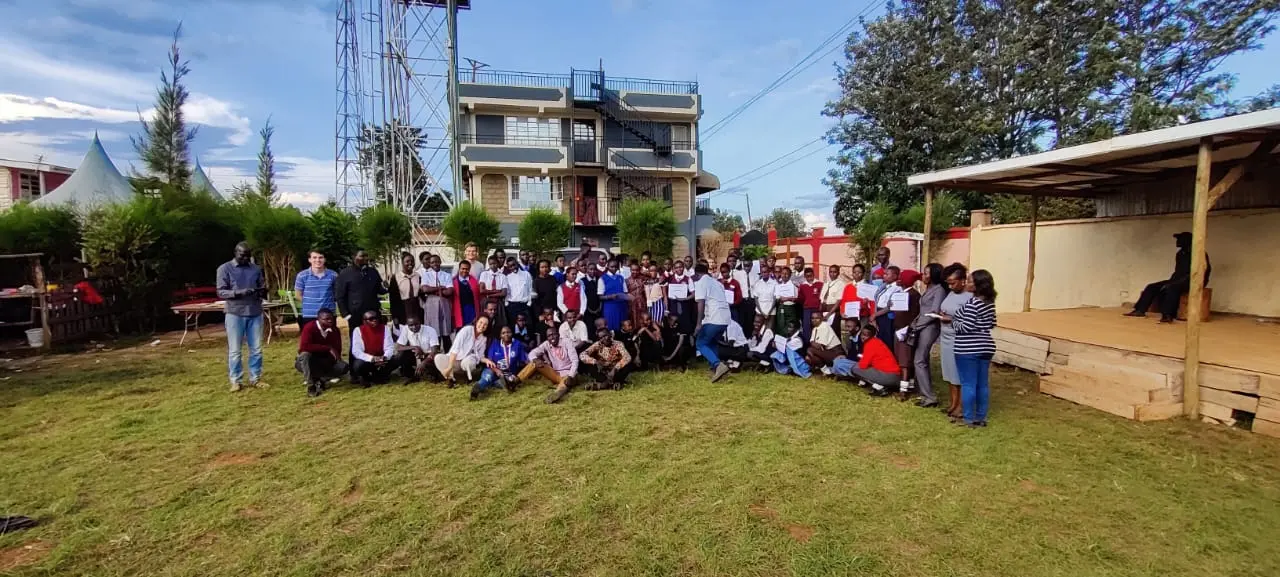
The goal of this report is to inform, inspire, and enable access to similar initiatives and learning resources developed for maths camps. The Kenya Maths Camp in December brought together 7 international volunteers and 7 local volunteers, who spent a week in preparation brainstorming new approaches to help students experience mathematics as an interesting, fun, and engaging subject. The goal was to make the students believe they are capable of learning anything. Teachers had the opportunity to grow professionally and learn new teaching techniques throughout the week-long preparation.
52 students joined the camp from 29 different schools around Kenya. The students were aged between 14 and 19 years with 73% of the students being female. This camp presented a bigger perspective on how to inspire the students to be aware of, understand, believe in, and be intrinsically motivated to learn through play and enjoy thinking in inclusive activities that revolve around 6 themes. The themes included programming and robotics, modelling, mathematical thinking, data science, games and puzzles. Here is a summary of the students' expectations at the beginning of the camp from the entry survey:

Fig: Summary of the students' expectations at the beginning of the camp from the entry survey
Themes

Fig: Showing Students Responses from the End of Camp Entry Survey
Programming and Robotics
Programming and robotics at the camp focussed on development of students logical and linguistic skills, project-based learning, problem solving, gamification, and cooperative learning through engaging the students in computational thinking as a way of planning, problem-solving and analysing information the same way a computer does as a way to logically think through problems, breaking them down into smaller pieces, identifying patterns, and then using the knowledge to come up with a step-by-step solution.
The end goal was to introduce the students to scratch through using human robot games, blockly games and programming using Edison robots. Learning how Edison works and its capabilities through barcode programming and programming Edison using blocks (Edblock) and in scratch (Edscratch). Scratch is a free and open-source programming tool for a wide range of users that allows them to learn, interact with, and create digital content in a simple and enjoyable way. They could stay linked to the project without losing the abilities they had learned while also learning about another method to engage with robotics in this way. The students were taken through creating a project in Scratch and created a shark attack game together.


Fig: Showing students programming Edison Robot and creating games in Scratch
Modelling
The ability to Model Mathematical activities and solve problems is a useful skill. One of the camp's themes was Modelling, which aimed to instil deep mathematical modelling skills in which students were encouraged to work and think, this included interactive processes that demanded creativity and inventiveness of the students in which mathematical, scientific and technical knowledge was applied to describe new situations. Throughout this theme, students were required to determine strategies, analysis or getting to the bottom of the problem provided and deploying Mathematical and computational tools.
Modelling sessions involved physical activities and playing experimental games incorporating data collection, analysing, recording, visualisation and presentation where students were actively and directly involved. Students worked in groups to come up with the statistical information and ideas for the Data collection session, used that information to present data using Geogebra and Excel.
Josephus Problem invited students to work in groups by mingling to make different numbers of groups and record the last number of students to remain standing in both the games. In this game students were to record the outcomes and make the observation and try to come up with the pattern and guess for the other numbers.
Moebius Strip and Moebius Crosses session was a simple experiment in which the students got into groups of five and played using a pair of scissors, pen for drawing a line, tape and several pieces of strips. They made different shapes and made observations on each shape.
Graphing Stories the session offers students the chance to explore functions and graphs in real-life contexts. It offered an opportunity for students to use their scientific understanding as they are invited to suggest plausible processes for each graph. Students had the opportunity to explore Desmos activity on reading the graphs.
Exponential growth of population activity is important and topical, a good example of the application of mathematics to a real life issue. It provides a basis for discussion of exponential growth and decay at a simple level. It provides data and graphs that give learners practice in interpretation and analysis and learning how to assess them critically. The activity provided practice for learners to recognize how to use GeoGebra on exponential functions, also in recognizing transformations of exponential functions and identifying the effects of transformations on the graphs of functions. Additionally, it introduces learners to higher level mathematics. The session is .here


Fig: Showing students modelling graphs and world cup matches during the 2022 Qa_tar World Cup
Mathematical Thinking
Participants in mathcamp are heavily encouraged to work on developing their problem-solving abilities, which includes using their critical thinking skills to identify patterns that can be beneficial.One of the themes that was prevalent in the camp was mathematical thinking. The subject had six sessions planned to be carried out in the mathcamp. This contains the factors and multiples, world cup combinatorics, Divisibility rule, Barcode trick, olympic rings and Venn Diagram. The sessions were designed to instil a serious issue. The sessions were designed to establish in the participants a solid understanding of mathematics, a methodical approach to thinking, and a high degree of organisation.
Factors and multiples a session driven by the ability to observe and formulate hypotheses into strategies. Participants looked at several puzzle grids that needed factor tricks to solve and deduce a plan of action.
World Cup combinatorics a session of inspiration from the current world cup matches. Participants investigate the mathematics underlying tournament organization, including the number of games in group rounds, the total number of teams participating in the knockout rounds, and the number of games played overall. They then use these findings to create their own tournaments with various team counts.

Fig: Showing Students entries about the session as recorded in daily journal
Divisibility rule a number is divisible by 2 if the last digit is a zero or even number. A lot of emphasis has always been placed on working with the divisibility test but not on gaining a thorough understanding of how it works.Participants were able to develop divisibility rules and were encouraged to develop their own using different numbers.
Barcodes since they help shops assign the right price and keep track of sales, bar codes are crucial. The 13-digit EAN bar code is supported by some amazing Maths. Participants could see how crucial the check digit is and how the scanner does calculations to match the check digit in order for the barcode to function properly.
The Olympic game/magic/ring session introduced learners to the concept of the use of venn diagrams. An olympic emblem (The Olympic emblem consists of five overlapping rings containing nine regions), was drawn and the main idea was to Place the numbers 1, 2, 3, … 9 in the nine regions so that the total in each ring is the same. Some students used trial and error to get the solutions but some students creatively found more systematic methods of getting the solutions. The session can be found here.
Venn diagram session introduced learners to a higher level of learning by grouping the numbers according to their properties. It also helped students to solve complex mathematical problems which were in the form of a riddle and provided an intuitive understanding of multiple regression analysis between more variables.
Data Science
Data science is becoming increasingly relevant in the workplace and everyday life; therefore, there was a need for camp participants to have the opportunity to work with data and view data science as inviting and feasible. The five sessions focussed on them understanding the world through data exploration. They worked with different data sets, summarised, visualised and interpreted data advancing their skills to use data as evidence to support their claims.
Introduction to Statistics. This was the opening session where we collected data from students as a student entry survey. Data collected during this session were used during other sessions like; data cleaning and statistical data analysis. The main objective of this session was to introduce students how to express their daily activities mathematically more so statistically.
Data Cleaning session was done where the data collected during maths camp entry survey session was fixed by removing incorrect, corrupted, incorrectly formatted, duplicate or incomplete data within that dataset. This was done by students with the help of instructions from facilitators.
Statistical data analysis session introduced the students to data analysis techniques. This session came after data collection and data cleaning sessions. Students were able to use a cleaned dataset to do the data analysis. They represented the data in form of 2-D pie charts and bar graphs. The session is here.
COVID-19 DATA session introduced learners to data interpretation. This session came after data collection, data cleaning, and data analysis sessions. Students were able to log into wordometers.com, narrowed down to live COVID-19 statistics, got the COVID-19 cases (confirmed positive cases, recovered cases, death cases) and analysed the data by themselves country by country. The session is here.
Gap-Minder Data visualisation is a crucial component that equips campers with the knowledge and abilities to critically understand and think about data. Gapminders is a program that provides data sets that participants can use to view and interpret.


Figure: Showing students working with data through analysis, exploring and discovering as they solve problems
Physical Activities
Physical activities offered the maths camp participants an opportunity to explore a fundamental number of concepts such as counting, sequence, one-to-one correspondence, number combinations, patterns, computation strategies and other important mathematical concepts. The physical activities that formed an integral part of this theme include Trading game, concentration game, flag game, mingle mingle, find the ball and treasure hunt.
Concentration games build concentration, good memory, better coordination and have fun. The participants and the team leader stand in a circle and the team leader says “concentration is the game, keep the rhythm if you can”. The crowd repeats, as they clap twice and tap their legs twice. Continue clapping like that. In the meantime, the leader says his own name twice and someone else's name twice.
Flag game The group is split into two teams and they then stand in two lines facing each other. One person needs to be in the middle to call and judge. In the middle of the two teams an (object) is placed. Each player is numbered with someone on the other side. Each round the caller calls a number and each matching pair must race to get the ball and get back to their line before being touched. If touched the ball goes to the other side, points may be kept.
Mingle mingle The players move around mingling as the leader chants" In twos, In threes etc" as the players from the groups with the total number that is said out aloud.
Find the ball This is a team activity involving one blind folded individual from a team who has to be directed by their respective team towards a certain object(ball). The activity fosters concentration on the part of the individual and proper teamwork from the team and communication.
Trading Game a lesson that taught learners how to collaborate, make decisions, and think critically. Participants had to go to artificial shops, where they could buy both legal and criminal things for 230 shillings, and they were permitted to profit from their purchases. To discourage the acquisition of illegal goods, the police were there. Each attendee got the chance to take something away from the session.

Fig: Showing flag game in progress
Games and Puzzles
The students solved various games and puzzles daily. The activities covered a number of areas including: Logic puzzles, Time distance maths, Brain Teasers, Probability concepts and Number challenge(s).
Puzzles were placed in the walls within their learning library section for the students to solve whenever they were free, most of the students could write them up in the evening and do as take home assignments. They found some of the puzzles challenging but they still found enjoyment in the process of discovery and solving them. They could then solve the challenging puzzles as a class every morning before the camp’s normal sessions start off.
Games and puzzles at the Camp gave the students the opportunities to explore problem solving concepts since they were able to take the role of facilitation. The students were more than just problem solvers, they supported others to engage in games and puzzles by making sure that: others understood the puzzles, encouraged them to ask questions for clarification, broke down the puzzle into smaller parts and they were able to reframe the puzzles. Games were played in groups, each group had a different facilitator for different games who was able to actively tell stories and create activities which related the mathematical ideas to spark memory for the other participants in the group.
Treasure hunt The maths camp treasure hunt taught the participants how much fun it is to solve problems in their own unique ways. It gave participants the chance to assist others in solving challenges by observing where they are and guiding them to the next move. To advance to the next station, teams have to solve puzzles. They will learn the upcoming puzzles at these stations. Through this self-directed activity, the participants learned the value of sequencing—the order of steps—and were given the freedom to finish a task independently in each of their respective groups. Before moving on to the treasure, each group completed at least eight puzzles out of the two that were provided at each station.
Quick Math Nine mathematics problems were given to participants every day for ten minutes before lunch. Renamed “quick maths” After the sessions, the students went into their houses, and each house received points for each accurate response. The lesson challenged students to utilise their minds alone, not calculators or any other tools.

Fig: Showing students solving quick maths
Journals
Students were encouraged to consider what went well, what could be improved, what they had learnt and constructive feedback then write anonymous notes and submit them the next day before the start of the session. These journals are useful in determining what works and what doesn't during the camp.
The journals were a great opportunity for the students to actively reflect on good and bad experiences, draw out key learning points and influence their future actions.


Fig: Showing sample of students journal entries recorded as daily at the camp
Houses
The four houses which consisted of students, participants and facilitators which were used as unique identifiers and distinguished with different colours were: Katherine Johnson(Orange) , Leonhard Euler(Green), Sophie Germain (Blue) and Blaise Pascal (Red).
Katherine Johnson was an American mathematician whose calculations of orbital mechanisms as a NASA employee were critical to the success of the first and subsequent U.S. crewed spaceflights. Leonhard Euler was a Swiss mathematician, physicist, astronomer, geographer, logician and engineer who founded the studies of graph theory and topology and made pioneering and influential discoveries in many other branches of mathematics. Sophie Germain was a French mathematician, physicist, and philosopher. Blaise Pascal was a French mathematician, physicist, inventor, philosopher, and Catholic writer.
Interaction was more efficient and enjoyable when participants were divided into houses. Working with others allowed them to pool their thoughts and look at problems from different angles. During competitions for example in physical activity and treasure hunt, members of the houses utilised a variety of skills and expertise they have to strategize and solve problems. Working in houses also allowed for more in-depth and broad research, as well as the opportunity to learn from one another by discussing, gaming, and playing, as well as exploring questions and thoughts and receiving feedback from peers.
Maths Game Ambassador and Next Steps
Since the training of level 1 ambassadors earlier in the year and inspiring active champions and ambassadors of maths games during both camps, the trained envoys are out of school and ready to learn together and serve the community in curriculum-agnostic mathematics. The library serves as a better centre for the follow up and set up a meeting come 2023.
The end of the maths camp was joined by one of the level one trained envoy of maths games from Friends School Kongoni Secondary School, Debora Nyaboke who is currently sitting her national exams. Debora has had an opportunity to attend a maths camp in October 2021 and March/April 2022 apart from being one of the 30 ambassadors trained and sworn as maths game ambassador in Feb 2022.
In her testimony during the closing, she wishes she would have attended the camps since her form one as her problem solving, communication and presentation, critical and logical thinking skills improved during her opportunity to join the camp and interact with students from different schools, facilitators and the activities introduced to during the camp.
Debora is looking forward to facilitating sessions at the next camp and inspiring other students to become champions and ambassadors of maths games. Debora, amongst other 24 students trained as level one ambassadors earlier this year will be out of secondary schools as they make plans for college applications and other engagements. The envoys will be available for next training as level 2 ambassadors as they get ready to inspire others to become active champions and ambassadors of maths games to support others to learn and play.
Conclusion
Kenya Maths Camp December 2022 brought together international volunteers from six different countries around the world amongst education officials and policy makers with interest in running maths camps in South Sudan and The Gambia come early 2023. The two weeks for preparation and camping brought the opportunity for volunteers to participate in creating and sharing new resources for the Kenyan camp as they think of how to plan and run camps in their countries, demonstrating that students can learn from interactions with computers and from each other.
The maths clubs initiatives in schools in tandem with the camps will scale the camps as 52 students who are potential maths game ambassadors from 29 schools were released back to introduce and play maths games with whoever they have access to including siblings, friends, classmates, family members, and support them to engage by embedding maths game activities into their daily activities. Teachers from the Network of schools who attended camp Reported that this year's national examinations required critical thinking to solve problems, an advantage to previous camp participants who were sitting and admitted the positive impact of the camp while they sat their examinations.
Special thanks to the kind sponsors: Supporting African Maths Initiative (SAMI), African Maths Initiative (AMI), INNODEMS, IDEMS and Kongoni Community Library (KCL) who made this maths camp a success. We’d like to offer our gratitude to Parents, teachers, individuals, schools, and organisations that sponsored students to this holiday maths camp.