
Kenya Math Camp January 2023
Akili STEMarts Academy, Kisumu County, Kenya
Date:16th - 20th January 2023
Introduction
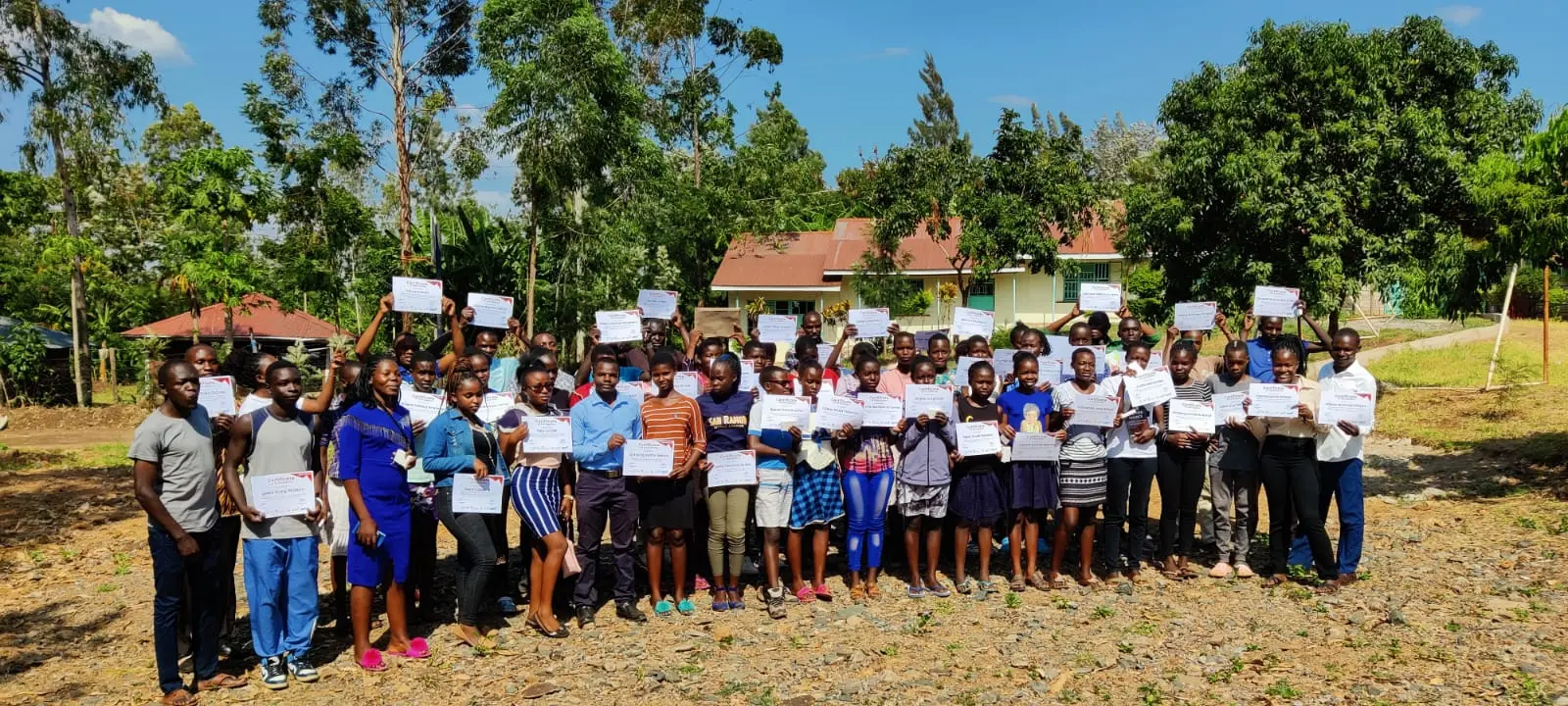
This report highlights the success in the planning and facilitation of activities, with brief description of the themes and activities facilitated during the kenya Maths Camp 2023 hosted at the Akili STEMarts Academy in Kisumu. The basis of this math camp was to present exciting themes to students on problem solving that will allow them to integrate the concepts into practice and inspire them to pursue careers in STEM subjects.
Teachers and volunteers met for a week to prepare and were trained as Maths game envoys with excitement to support everyone in engaging in thinking through inclusive, fun activities. The students were introduced to different themes through activities and experiences and learnt skills in computational thinking, logical thinking, critical thinking, and mathematical thinking that are useful to address the central theme in problem solving.
The Camp brought together 37 students from 18 secondary schools around the country. The students were taken through seven themes that integrated technological use in collaborative activities where everyone—including the accompanying teachers—learned through fun activities. The themes included mathematical thinking, data science, programming and robotics, physical activity, treasure hunt, modeling, and games and puzzles.
After a lengthy break, the students will return to class to support others in learning and using the resources provided as ambassadors for math games and to run math clubs employing the activities from the VMC card decks.
Themes

Fig: Students experiences as filled in end of camp feedback concerning the themes at the camp
Programming and Robotics
Programming and robotics sessions introduced students to problem solving through logical and linguistic skills, and computational skills to investigate how a computer ‘thinks’ and a chance to give a real-world setting in which to apply curricular concepts.
The students engaged in hands-on sessions involving writing programs to give directions to a volunteer as a human robot in a maze in order to create a good computer program for any particular robot. This theme engaged the students in computational thinking as a way of planning, problem-solving and analyzing information the same way a computer does as a way to logically think through problems, breaking them down into smaller pieces, identifying patterns, and then using the knowledge to come up with a step-by-step solution.
The sessions introduced students to programming by issuing instructions through dragging and dropping to join blocks in blockly games and working with Edison robot, using blocks and in scratch before further proceeding to scratch to create games and animations as projects.
The students used graphical blocks to represent code concepts like variables, loops, logical expressions and more. This allowed students to focus on learning the programming fundamentals without having to worry about the syntax.
Modeling
Challenges from real life can be translated into mathematical language through modeling problems and assessing the solution in the real world. It was clear that numerous tools, like Geogebra and physical sessions to simulate how models work and converted to math language, were used to make these theme goals a success.
Josephus Problem session was an extension to mingling game where the students were encouraged to get into groups of different numbers and make a circle, player at position one was to point player at position two and position two had to sit down and it continues until the last player remain standing and was to record the last number of player standing.
Josephus Problem introduced students to pattern and sequence and the students were to record the numbers of last player remaining standing and come up with the observation which was to help them guess the pattern as the number of players increased.
Exponential growth of population activity is important and topical, a good example of the application of mathematics to a real life issue. It provides a basis for discussion of exponential growth and decay at a simple level. It provides data and graphs that give learners practice in interpretation and analysis and learning how to assess them critically. The activity provided practice for learners to recognize how to use GeoGebra on exponential functions, also in recognizing transformations of exponential functions and identifying the effects of transformations on the graphs of functions. Additionally, it introduces learners to higher level mathematics. The session is here.
Detours introduced the triangle inequality in a more interactive way using matchsticks and Geogebra. At first students used matchsticks to make triangles of different types (Right angled, equilateral e.t.c) and recorded their edge(s) length. We then used the edges recorded to prove which ones satisfy the triangular inequality and which ones do not. We discovered that some fit and others don’t. This implies that their modeling was subject to errors. We then proceeded to use the GeoGebra tool and came up with different sets of perfect triangles which all could fit the triangular inequality. The session can be accessed here.

Fig: Showing students reflection entries on detours as recorded in daily journal
Disease spread Dynamics session introduced learners to modeling of infectious diseases in higher levels of learning. This lesson focuses on explaining to students the networks involved in disease spread in a given population. It also introduced learners to understand the concept of basic reproduction number, how it is calculated, and how its value affects disease spread (when the value is negative, positive or equal to one). Students in the whole class were involved to form the network involved in disease spread. The session can be found here.

Fig: Showing Students entries about the session as recorded in daily journal
Vaccination game
Kinematics The entire field of calculus can be used to simulate real-world events. Calculus can be used to describe the concept of displacement, velocity, and acceleration, which is also referred to as kinematics. Participants in the math camp had the chance to simulate displacement, velocity, and acceleration and comprehend their importance in everyday life.
Mathematical Thinking
Thinking mathematically to solve problems is strongly encouraged at mathcamp, which includes using critical thinking skills to identify patterns that are useful. One of the camp's recurring themes was mathematical thinking. Six sessions were planned for the subject during the mathcamp. This includes the factors and multiples, binary numbers, the barcode trick, the Olympic rings, Venn Diagram, the frogs party and Joseph problem. The lessons were made to implant in the participants a strong grasp of mathematics,organization and a methodical way of thinking.
Magic squares: The session contained squares with whole numbers written inside each cell, so that the total sum of every number in each row and column, and in each primary and secondary diagonal is equal. During the session, we used 3*3 squares with the use of numbers 1 to 9 total sum is 15. Students arranged numbers in cells in different ways to solve the square. The session was the foundation of other mathematical thinking sessions.
Factors and multiples: The session is advancing on magic squares driven by the ability to observe and formulate hypotheses into strategies. Participants looked at several puzzle grids that needed factor tricks to solve and deduce a plan of action.
Barcodes are essential because they assist retailers in setting the appropriate pricing and monitoring sales. EAN bar codes of 13 digits are supported by some incredible math. Participants were able to observe how important the check digit is and how the scanner performs computations to match the check digit.
Binary Numbers Math ideas can be taught through magic tricks. The use of magic tricks to introduce binary to math camp participants was the ideal situation. Recognizing binary digits and using 0s and 1s to represent numbers. Converting numbers to binary place value improved understanding of the notion of binary.
The Olympic game/magic/ring session introduced learners to the concept of the use of venn diagrams. An olympic emblem (The Olympic emblem consists of five overlapping rings containing nine regions), was drawn and the main idea was to Place the numbers 1, 2, 3, … 9 in the nine regions so that the total in each ring is the same. Some students used trial and error to get the solutions but some students creatively found more systematic methods of getting the solutions. The session can be found here.

Fig: Showing Students entries about the session as recorded in daily journal
Venn diagram session introduced learners to a higher level of learning by grouping the numbers according to their properties. It also helped students to solve complex mathematical problems which were in the form of a riddle and provided an intuitive understanding of multiple regression analysis between more variables.
Data Science
The camp participants worked with data in 6 different sessions focussed on data entry, examining data displays, coming up with a questionnaire, data collection, exploring data, discovering with data and problem solving with data. They worked with different data sets, summarized, visualized and interpreted data advancing their skills to use data as evidence to support their claims.
Introduction to Statistics It was the opening session. We introduced the session by collecting data from students as a student entry survey. Data collected during the session were used during other sessions like; data cleaning and statistical data analysis. In the session, students were introduced to data collection techniques like questionnaires. An example of statistical data was the average life of Kenyan life and students came up with questionnaires about average student life. The main objective of this session was to introduce students to how to express their daily activities mathematically more so statistically.Here are students questionnaires


Fig: Sample questions from students investigating the ‘average students’ life’.
Data Cleaning session was done where the data collected during maths camp entry survey session was fixed by removing incorrect, corrupted, incorrectly formatted, duplicate or incomplete data within that dataset. This was done by students with the help of instructions from facilitators. Data collected in a data entry survey was used to display how data cleaning is done.

Figure: Students getting involved in data cleaning session
Statistical data analysis session introduced the students to data analysis techniques. This session came after data collection and data cleaning sessions. Students were able to use a cleaned dataset to do the data analysis. They represented the data in form of 2-D pie charts and bar graphs. The session is here.

Figure: Students getting involved in statistical data analysis session
GapMinder session introduced students to Data Visualization. Students had the opportunity to think about the gap in the world today and challenge preconceived ideas about how the contemporary world looks.
Students were able to discover different attributes of countries that make other countries famous and better than others. Students used different data provided on Gapminder and presented it on Excel by coming up with different presentations like pie charts, bar graphs and line graphs. This was to show that they were able to understand the previous session on Statistical Data analysis in which they were introduced to Excel as one way of representing Data.
Students explored Gapminder and used the data provided to show their Problem Solving technique.
Physical Activities
The camp programs included enjoyable, inclusive games where everyone was expected to participate in outdoor physical activities. Physical activities gave all math campers a chance to study a variety of core ideas, including counting, patterns, computing techniques, and other significant mathematical ideas. This theme's physical activities included the following games: concentration game, flag game, mingle mingle, find the ball,buzz, Card game and treasure hunt.
Concentration games enhance your memory, coordination, and focus while having fun. The team leader tells the members to focus on the game and try to keep the beat while they stand in a circle. The crowd claps twice and taps its legs twice before repeating. Keep clapping in that manner. The leader alternates between saying his own name twice and another person's name twice.
Flag game after being divided into two teams, the individuals stand in two lines facing one another. To call and decide, one person must be in the center. An object is placed in the center of the two teams. Each player is paired with a number from the opposing side. Each time a matching pair is called, they have one round to race to retrieve the ball and return to their line without being touched. Points may be kept if the ball touches someone before going to the other side.
Card game Cards ranging from Ace to Ten are dealt to each team. Each team's 10 cards are dealt face down at random onto a table in front of them. The players run up one at a time and flip a card over. If it isn't the Ace, they turn it over again and sprint back to their team, where the following player gets a turn. They can lay the ace face up at the head of the table once it has been revealed. Card two is needed next, and so on. Play continues until one team has all of its cards properly flipped face up.
Buzz The participants sit in a huge circle. The count begins with one player stating "1," and continues around the circle with the next player shouting "2." Any number that contains a 3 or is divisible by 3 needs to have the word "Buzz" substituted for it. When someone makes a mistake, the game resumes at step 1.
Mingle mingle The leader chants, "In twos, In threes, etc." as the players from the groups with the total number that is spoken aloud go around mingling.
Find the ball This is a group activity where each team must guide a member of their team who is blindfolded towards a specific object. The activity encourages effective teamwork from the team as well as communication and individual focus.
Games and Puzzles
The students solved various games and puzzles daily. The activities covered a number of areas including: Logic puzzles, Time distance maths, Brain Teasers, Probability concepts and Number challenge(s).
Puzzles were placed in the walls within their learning library section for the students to solve whenever they were free, most of the students could write them up in the evening and do as take home assignments. They found some of the puzzles challenging but they still found enjoyment in the process of discovery and solving them. They could then solve the challenging puzzles as a class every morning before the camp’s normal sessions start off.
Games and puzzles at the Camp gave the students the opportunities to explore problem solving concepts since they were able to take the role of facilitation. The students were more than just problem solvers, they supported others to engage in games and puzzles by making sure that: others understood the puzzles, encouraged them to ask questions for clarification, broke down the puzzle into smaller parts and they were able to reframe the puzzles. Games were played in groups, each group had a different facilitator for different games who was able to actively tell stories and create activities which related the mathematical ideas to spark memory for the other participants in the group.
Treasure hunt Maths Camp Treasure Hunt taught students the importance of working together and embracing teamwork, collaboration and discussion. It was fun for students to solve puzzles as a group. Treasure Hunt encouraged students to seek guidance from facilitators each time they were not able to solve challenges after getting hints, they were able to solve the puzzles.
To move on to the next station, each group had to solve two puzzles in which they added the sum of the two solutions which was the location for the next station. They then have to read the map and find the location of the sum on the Map.
Quick Math session involved Eight mathematics problems were given to participants every day for ten minutes before lunch. Renamed “Quick Math” During this session, the students went into their houses, and each house received points for each accurate response. The lesson challenged students to utilize their minds alone, no pens,no calculators. The questions displayed in this session normally build on each other concept-wise from day one.
Journals
Students were encouraged to consider what went well, what they did not understand,what could be improved, what they had learnt and constructive feedback then write anonymous notes and submit them the next day before the start of the session. These journals are useful in determining what works and what doesn't during the camp.
The journals were a great opportunity for the students to actively reflect on good and bad experiences, draw out key learning points and influence their future actions. Here are the students' journals as per day; day one, two, three, four.


Fig : Sample students journals from the camp.
Houses
There were four houses in the camp that set the participants apart from one another, in teams, for collaboration during sessions that encouraged inter-house competitions. There were four houses, each with distinctive colors including Ana Caraiane (red), Stephen Hawking (green), Sandra Faber (white) and George Washingtonn (blue).
Ana Caraiane, a mathematician awarded for her contributions to arithmetic geometry and number theory. in particular p--adic langland program. Stephen Hawking, a theoretical physicist and cosmologist. Stephen discovered black holes emit radiation which can be detected by special instruments. back hole- a region of space having a gravitational field so intense that no matter or radiation can escape. Sandra Faber, an astrophysicist who linked the brightness of galaxies to the speed of stars. George Washingtonn, a prominent black scientist & botanist who discovered 100 uses for peanuts.
Maths Game Ambassador and Next Steps
We are looking forward to intrinsically motivated, pro-active, and inspired ambassadors of math games ambassadors who are prepared to use math games and puzzles to develop and enhance numeracy skills (mathematical literacy), critical thinking, and deductive skills after training 10 new ambassadors of math games during the preparation week and introducing the idea of being an ambassador to the camp participants.
We are excited to work collaboratively with Akili STEMarts Academy to train and assist more ambassadors to introduce and play math games with people throughout this region (Kisumu) by exposing people to various types of fun and engaging activities that foster mathematical thinking, play math games with anyone they have access to including siblings, friends, classmates, family members, acquaintances, etc.
Conclusion
The majority of the students awaiting entry into secondary schools had the chance to learn math from a problem-solving approach and the importance of math in STEM fields during this year's first math camp hosted in Kisumu, Kenya. The group of learners who had never had the chance to participate in a math camp before liked the beauty and fun that came with learning math through games.
While we make plans for a future camp in this area, we have trained a number of ambassadors and students who will be supported throughout the term in establishing and running math clubs to encourage others to participate by incorporating math game activities into their regular activities.
Special thanks to the kind sponsors: Supporting African Maths Initiative (SAMI), African Maths Initiative (AMI), and Akili STEMarts Academy who made this maths camp a success. We’d like to offer our gratitude to Parents, teachers, individuals, schools, and organizations that sponsored students (ROF) to this holiday maths camp