
Fueling Ethiopia’s Future Coders: Algebra to Algorithms
In July 2023, Bahir Dar University hosted its 10th BDU Math Camp. The camp has been running for a decade with the same idea at its core: students learn mathematics better when they are having fun. This year’s camp continued that tradition, but with a stronger focus on skills that matter in a technology-driven world.
Ethiopia’s young people are growing up in a time shaped by digital systems, artificial intelligence, and global networks. The camp tried to meet this reality by teaching maths that students can use in programming, science, and data work. It focused less on exam preparation and more on skills that support future work and study.
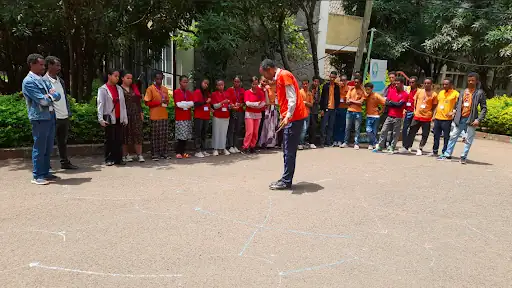
Over one week, 56 secondary students explored topics that are usually taught at university level. They worked with programming, cryptography, mathematical modeling, and algorithms. The goal was not to teach theory for its own sake, but to help students learn how to solve problems.
Programming was a major part of the camp. Students learned basic syntax, worked with Blockly and Scratch, and used robotics to test their logic. These sessions encouraged them to write instructions, find mistakes, and fix them, which is central to coding.
The sessions on cryptography introduced modulo arithmetic, encryption, and decryption. Students explored how mathematical rules protect information. They did this through simple tasks that showed how secure communication works in practice, not just in theory.
Another set of activities focused on modeling real-world issues. Students looked at disease spread, population change, and game theory. They used maths to explain patterns and decision-making. These sessions encouraged students to see mathematics as a tool for understanding society and the environment.
The algorithms theme introduced binary numbers and sorting methods. These topics are common in computer science, but rare in secondary school. Students practiced breaking problems into steps and thinking about efficiency.
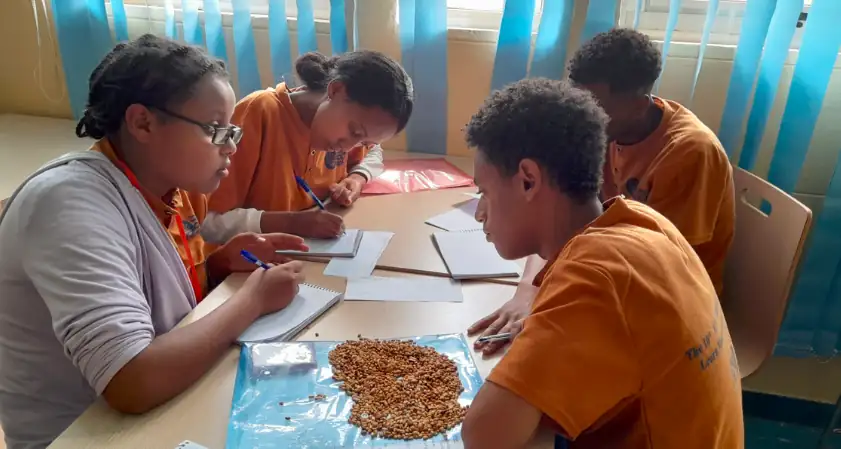
The camp did not rely on lectures. Activities included card games, outdoor exercises, puzzles, and a treasure hunt. Students worked in groups, moved around, and competed with each other. They learned mathematical ideas while playing. This mix of movement and thinking helped students stay engaged, even when the topics were difficult.
Robotics labs, GeoGebra investigations, and other hands-on tasks helped students test ideas instead of memorizing them. The camp supported experimentation, failure, and revision. Students were encouraged to try things, see what happened, and adjust.
The camp showed that young people are interested in mathematics when it feels practical and connected to their lives. Many learners responded well to the combination of advanced content and active learning.
But running a camp like this takes time, money, and coordination. Bahir Dar University covered most logistics, and SAMI filled key gaps. Demand for the camp continues to grow, but resources do not always match interest.
If more students are to benefit from this approach, continued support will be necessary. The work is promising, but it needs stability to reach more schools and communities.